Wednesday, March 10, 2021

Health and Disease in ancient times...

 This topic is from the third lecture of "Overlooked Archaeology." We covered heart disease and many other ailments in overstudied mummies such as the Italian Iceman and the Chinese noblewoman Lady Dai. We also discussed DNA studies of teeth, which reveal diet, disease, and migration patterns, ancient surgery and medicine, evidence of tooth decay in skeletal remains, and early dental remedies.

Videos: 

Carolyn Freiwald on Tales from Teeth

A humorous medical clip about Galen, ancient Rome's most notorious doctor

Websites: 

The Iceman's poor health

Lady Dai, Chinese mummy

Woman the Hunter 

The Beaded burial at Cahokia

The death of Pliny from going too near an erupting volcano


Wednesday, March 3, 2021

Overlooked Archaeology, lecture 2 notes and links

 During our second lecture, we finished up a discussion of ancient pets and animals in religion and moved on to ancient sanitation (especially in Roman cities) and the procuring of food before corn agriculture in Illinois. The last major topic was consumables: wine, beer, olive oil, insect repellent, chocolate, and the "black drink" of North America.

Videos:

A cherished pet bobkitten in Illinois

Plumbing at Petra in Jordan that allowed for gardens and swimming pools in a desert setting

Interesting links:

Plumbing: great article on Roman sanitation.

Vegetarian diet in Egypt

How the Egyptian pyramid workers got fed

Mesopotamian recipes

Early French wine-making

Cahokia black drink 


Tuesday, February 23, 2021

Overlooked Archaeology

I am currently teaching a course, “Overlooked Archaeology, at the Osher Lifelong Learning Institute at the University of Illinois (February-March 2021). The title “overlooked” means topics I have not addressed before, not ones that professional archaeologists ignore. It allows me to explore the odder byways of my profession while still incorporating recent advances and new information that I discover in magazines like Archaeology, The Biblical Archaeology Review, or from headlines in the New York Times or New Scientist.

Class Description:

Hollywood archaeology features spectacular discoveries of jewel-laden tombs and lost temples. In everyday archaeology, many discoveries are made far from the original site: in the laboratory, in a museum, or on a computer. Technological advances, especially in the biological sciences, make it possible to investigate everything from ancient medicine to the evolution of agriculture. New kinds of imaging and remote sensing help us read obscured texts and map roadways and underground structures. This class explores some of the odder byways of archaeology: domesticated dogs, beer-making, dental health, pleasure gardens, and locating new sites from space.

In lecture one, we talked about how the discipline of archaeology began with excavating large public buildings (tombs, temples, meeting halls) and collecting inorganic materials (metal, stone, and ceramic). Over time, the focus has shifted to domestic architecture and the artifacts of daily life: private homes, garbage pits, the graves of commoners, and even historic privies. I introduced the domestic architecture of three sites widely separated in space and time: Skara Brae (Scotland), Karanis (Egypt), and Ostia, Italy. We also began a section on ancient pets with the domestication of dogs.

          Video links:

Skara Brae

Roman Ostia 

Book recommendations:


Sarah Parcak, Archaeology from Space

Paul Bahn, The Bluffer’s Guide to Archaeology

Karanis: A Roman town in Egypt (Kelsey Museum Publication 1)

 Authors who write wonderful fiction about ancient Rome and Romans:

Lindsey Davis, Simon Scarrow, Steven Saylor (all use rich historical detail and archaeological records)

 *For more archaeological fiction, check out this review site: https://mvac.uwlax.edu/book-reviews/ (includes a few of my own novels)

Resources for Illinois and Midwestern archaeology:

Our own IllinoisState Archaeological Survey

East Central Illinois Archaeological Society (ECIAS), part of the Illinois Association for the Advancement of Archaeology: http://www.museum.state.il.us/iaaa/easthome.htm

Local lectures and some volunteer opportunities are available (and will return after COVID).

Midwestern cultures (focus on Wisconsin): https://mvac.uwlax.edu/PreEuropeanPeople/


Sunday, June 14, 2020

Famous Forgeries and Other Works of Art

Today's blog accompanies a lecture, "Unmasking Art Forgeries," I am giving at our local Osher Lifelong Learning Center.

Below are the links I promised.


THE CASE OF THE J. PAUL GETTY MUSEUM KOUROS

One of my earlier blogs on this topic (a summary of the research findings) 
The Getty museums's own catalog entry on the Kouros

THE CASE OF THE SHROUD OF TURIN
A good summary website  (there are many, many more if you google the Shroud!)
Microscopist Walter McCrone's research, with links to his technical articles

THE CASE OF THE GEORGIA O'KEEFFE WATERCOLORS
Magazine article from 2000.
A paper conservator's report


Finally, although this is an older book, it is a wonderful summary of how science can help museums evaluate their collections: Science and the Past, edited by Sheridan Boman (University of Toronto Press, 1991)

Sunday, February 16, 2020

Altamira and portable art

Last week we viewed the paintings of Altamira, also called the "Spanish Lascaux." Discovered too early by a father and daughter (who caught his attention by saying, "look, Daddy, oxen!") Saultola was ridiculed by leading prehistorians. The paintings are too colorful, too wonderful to have been made by Paleolithic artists--they must be fakes. This was typical of scholarly thought of the time, because believing the paintings were real would have turned theories of what prehistoric humans were capable of upside down.


We also examined the lifestyles of the people who painted the caves of southwestern France and northern Spain. Contrary to popular belief, these people were not just "big game hunters," but mobile foragers who made full use of available plants, small animals, birds, and fish to feed themselves. They also fashioned stone and bone tools, many decorated with pigment and incised designs, and had a complex system of geometric signs (National Geographic video on sign interpretation).

Whether the signs constitute an early form of language or writing is very much up for debate, but some signs--especially the red dots used on certain rock formations and near the end of passages clearly had meaning. Did the dots mean "great acoustic space," or "don't go any further, the cave gets dangerous"? No one knows.

One student sent me a video on the evolution of language, which discusses a theory that the key difference between Neanderthals and Homo sapiens is that the latter had full speech capability and that this gave modern humans a survival advantage over Neanderthals. The video is intriguing but does not take into account the most recent discoveries of Neanderthal capabilities for abstract thought and representational art. And scholars disagree about how much Neanderthals could speak: their vocal tracts were sufficiently developed for a range of one-syllable sounds which, when combined with geometric signs on painted walls and decorated objects, could have communicated a range of ideas.

More (New Scientist article 2016) on geometric signs and work of Genevieve von Petzinger

Monday, February 10, 2020

More Paleolithic Fun

In week 2, we looked at the Ice Age environment for cave paintings in Europe. Climate data (from pollen analysis and oxygen isotopes) shows considerable variation in temperature and humidity as the glaciers advanced and retreated. Also, southwestern France and northern Spain, the locations of the caves we are studying were for the most part ice-free.

 Altamira ceiling


The environment was rich with large and small fauna, plants, and fish (for those living near the coast), so it makes sense that people of the Paleolithic did actually have some leisure time to spend making art--both portable and wall art. To get a good sense of the full range of living creatures, it's important to look at both kinds of art (many animals depicted on small rock plaques and carved bones are not the ones commonly seen in the cave paintings).

The stars of our class so far are European Neanderthals who were living and painting in Spain at least 65,000 years ago. A host of recent articles in newspapers and journals attest to Neanderthals' capabilities in managing fire, cooking, preparing pigments, and painting animals and symbols on cave walls.

Great video on Neanderthal capabilities in Spanish caves.

Article on Neanderthal fire starter
Another book I have found extremely useful: Journey through the Ice Age (1997), by Paul Bahn and  Jean Vertut


Monday, February 3, 2020

Art and Archaeology of Stone Age Europe

I am teaching a course this month at our local Osher Lifelong Learning Institute with 100 students who are aged 50 and better!

The topic was inspired by a National Geographic trip to the Paleolithic painted caves of France and Spain two years ago.

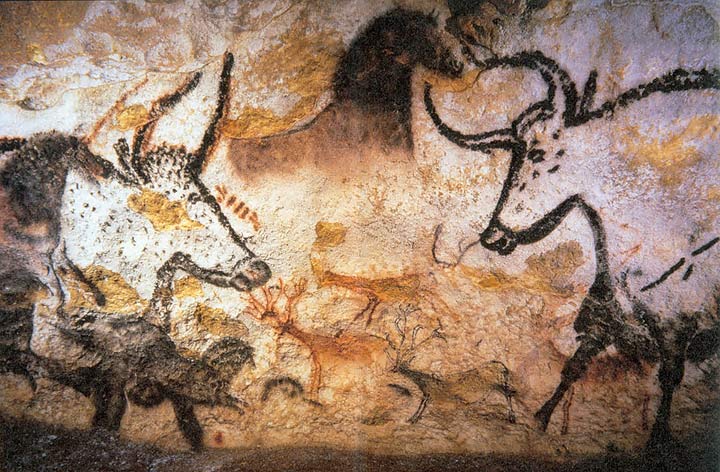
Lascaux painting.jpg

Lascaux: aurochs (oxen), horses, and deer

The class explores European cave art, especially the art from painted caves in southwestern France and northern Spain. What are the limits of the evidence, and what can we learn from cave paintings? Do the paintings represent the spiritual world instead of daily life? What is the relationship between painted animals, shamanism, and subsistence? Did women create some of the paintings? Which caves were also used as meeting places and trade centers? Other topics will include portable art, the use of fire for lighting, heating, and cooking, and how people moved across the landscapes of early Europe and the Americas.

Here is a Nat Geo video with a great introduction to the painted caves of France. 

An Australian named Don Hitchcock has created an amazing website about Paleolithic sites all over Europe, with quite a lot of other information! This was important for me since we were not allowed to take photographs during most of our trip (the caves that are still open needed to have their paintings protected from bright lights and the CO2 of thousands of visitors).

Here are two of my favorite books on the subject:

Paul Bahn, The First Artists: In Search of the World's Oldest Art (2017)

Paul Bahn, Cave Art: A Guide to the Decorated Ice Age Caves of Europe (2007).

I will post more images and websites in the next three weeks.